
By John Hipchen, Director of Energy and Electrical Systems Council for the Copper Development...
By Adam Estelle, President & CEO, Copper Development Association
Brass rod can support drinking water safety, long service life, sustainability goals, and competitive total cost.
Topics: brass rod, material selection, drinking water safety, NSF/ANSI/CAN 61, building systems, plumbing, service life, embodied carbon, recycled content, machinability, alloy selection
Standard discussed: NSF/ANSI/CAN 61-2024
Summary: Why Use Brass Rod in Modern Systems
Brass rod is ideal for valves, fittings, water meter components, fire suppression systems, and other precision-manufactured parts used in modern buildings because it meets drinking water safety standards, resists corrosion without coatings, creates pressure-tight seals, is easily machined, is 100% recyclable, and has high recycled content.
• Seven brass rod alloys have a rare “Acceptable Materials” designation under NSF/ANSI/CAN 61-2024 for drinking water applications.
• Corrosion resistance is inherent, and alloy choice affects performance in different operating environments.
• Brass is 100% recyclable, and many brass rod alloys contain over 90% recycled content as demonstrated through a recent independent certification.
• Cost benefits include faster and more energy-efficient machining, high residual scrap value, avoidance of coatings for corrosion protection, familiar installation practices, and durability.
How Brass Rod Supports Drinking Water Safety
For potable-water components, the central question is what the material can release into drinking water. NSF/ANSI/CAN 61 establishes health-effects criteria for materials, components, products, and systems that contact drinking water. The 2024 edition covers 14 regulated metals, including lead, arsenic, and chromium, and introduced significantly tighter lead-leaching criteria.
The 2024 edition lists seven brass rod alloys as “Acceptable Materials”: UNS C27250, C27550, C49100, C69300, C69850, C89833, and C89835, which were earned after satisfying rigorous testing requirements. Brass rod was the first material class to receive this designation in more than 20 years. The designation allows manufacturers of certain qualifying products to avoid recurring testing and certification requirements and related costs, depending on design parameters and operating environments.
For designers and standards groups, the practical value is confidence earlier in the process. Material-level acceptance establishes a documented compliance pathway before a team commits to a specific product, while preserving the need to confirm the alloy, application, and design parameters.
Why Brass Components Support Long Service Life
Components behind walls or overhead in mechanical rooms are judged by the failures that never happen. Brass earns its service record through performance properties intrinsic to the base metal, rather than relying on coatings that can be applied inconsistently, damaged, or worn away.
Brass does not rust like ferrous components containing iron and often does not require plating for corrosion protection. Its machinability and malleability support precise threads and pressure-tight seals that prevent leaks, and brass is also used in fire safety, fuel gas, and other demanding systems that must operate effectively, efficiently, and safely throughout the building's lifetime.
Specification insight: Corrosion resistance varies across brass alloy families, and aggressive water chemistries can expose these differences. Specify the alloy, not only the metal, and confirm its suitability with the manufacturer or project engineer.
Technical references: Brass vs. Plated Steel Corrosion Testing.
How Brass Rod Supports Sustainability and Procurement Goals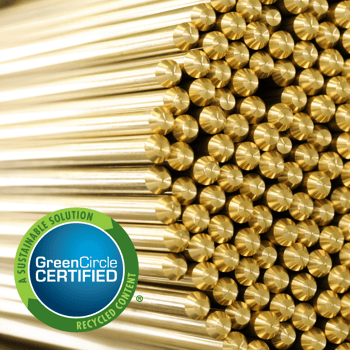
Embodied-carbon requirements and Buy Clean policies have made material origin, recycled content, and end-of-life recovery part of procurement review for certain market segments. Brass rod offers a clear circularity story when documentation is tied to the actual alloy and supplier.
Brass rod is 100% recyclable, and the U.S. brass rod industry, represented by CDA, recently secured an independent recycled content certification from GreenCircle Certified, LLC. The certification validates that the industry maintained a minimum of 92% recycled content for all outgoing materials cast onsite at participating brass rod mills in 2023, representing over 85% of domestic mill shipments. This certification marked the first widely recognized industry-average recycled-content claim for a U.S.-produced copper or copper alloy semi-finished product.
Importantly, high recycled content is not inherently a performance trade-off: properly controlled recycled feedstock is manufactured to the same alloy composition, mechanical properties, and machining requirements.
Moreover, closed-loop buy-back programs can return clean brass turnings and process scrap to a mill for remelting into new rod. The recovery value of brass scrap can also be credited against raw material cost.
Specification insight: For green-building submittals, document the product-specific recycled content, supplier, alloy, and available environmental declarations rather than relying on a category-wide assumption.
Technical references: Brass Rod Recycled Content Certification
Why Brass Can Reduce Total Cost per Finished Component
Material substitution requests often compare raw material costs, but a large share of a precision component's cost is attributable to machining. Total part cost is influenced by multiple variables, including cycle time, tool life, machining energy, finishing requirements, scrap recovery and value, installation, maintenance, and failure risk.
In the theoretical comparison below for a complex CNC part, free-cutting brass is indexed at 100 for machinability, and free-cutting steel at 21, resulting in more material removed per minute with brass and about half the production-run energy for brass.
|
Theoretical part machining comparison |
Free-cutting brass |
Free-cutting steel |
Ratio |
|
Machinability rating (0–100 scale) |
100 |
21 |
— |
|
Optimized material removed per minute |
0.238 in³ |
0.114 in³ |
2.1x |
|
Energy for the same production run |
9,475 kWh |
18,931 kWh |
0.5x |
Sources: Copper Development Association, Comparative Machinability of Brasses, Steels, and Aluminum Alloys; Brass Rod: The Sustainable Choice. Theoretical example provided for illustrative purposes only. Actual results vary by alloy, part geometry, machine tool, cutting tools, and other process parameters.
Faster machining, longer tool life, higher residual scrap value, and lower energy per part are embedded in the component manufacturer's cost structure, upstream of any bid. That helps explain why finished brass components are competitive against parts made from alternative raw materials that may cost less on the front end.
Installation also matters. Brass and copper joining methods are familiar to the plumbing and mechanical trades, which can reduce field uncertainty. A substitution that saves on material but adds installation time, callbacks, or maintenance risk may increase total cost.
When Brass Rod Is the Right Material Choice
Brass rod is especially well-suited to small, precise, long-lived components that contact water or require reliable threads, pressure tightness, corrosion resistance, non-sparking properties, and efficient machining. Its case has strengthened as drinking-water criteria have tightened and procurement teams have placed more weight on recycled content and lifecycle performance in certain market segments.
For design teams and owner standards groups revisiting product packages, the decision should be made at the alloy level. Confirm the UNS alloy, applicable NSF/ANSI/CAN 61 conditions, water chemistry, mechanical requirements, manufacturing process, and supplier documentation. CDA and its members can provide technical expertise, market knowledge, regulatory compliance guidance, and end-user support.
Brass is not the right answer for every application. It is generally not a substitute for structural applications, and some aggressive water chemistries may call for a different brass alloy or another material. The sound specification is the material and alloy that fits the actual service conditions.
Frequently Asked Questions About Brass Rod in Building Systems
Copper Development Association Sources and Further Reading
Brass Rod: The Safe Choice [INFOGRAPHIC]
Brass Rod: The Secure Choice [INFOGRAPHIC]
Brass Rod: The Sustainable Choice [INFOGRAPHIC]
NSF/ANSI/CAN 61-2024 and the seven Acceptable Materials brass rod alloys
Recycled-content certification for U.S. brass rod
Technical note on dezincification and brass alloy selection
Working through a material decision on building-system components? CDA works with designers, engineers, and owner standards groups on alloy selection, water-quality requirements, and sustainability documentation. Contact CDA to learn more.