

By Adam Estelle, President & CEO, Copper Development Association Brass rod can support drinking...
By John Hipchen, Director of Energy and Electrical Systems Council for the Copper Development Association
Copper is a primary conductor material in commercial building electrical systems because of its high electrical conductivity, favorable thermal properties, and long-term connection reliability. These characteristics reduce I²R losses, optimize conductor sizing to meet ampacity requirements, improve termination integrity, and lower lifecycle costs in high-demand building environments.
Electrical Efficiency as a System Design Requirement
In modern commercial construction, electrical system design is increasingly driven by performance criteria rather than first-cost considerations. Rising load densities, continuous operating profiles, and growing interaction with constrained utility infrastructure have heightened the importance of conductor efficiency.
From a design standpoint, conductor material selection directly affects wire size, ampacity, voltage drop, thermal limits, and long-term system reliability parameters governed by codes and standards such as the National Electrical Code (NEC) and relevant IEEE guidelines.
Resistive Losses and System Performance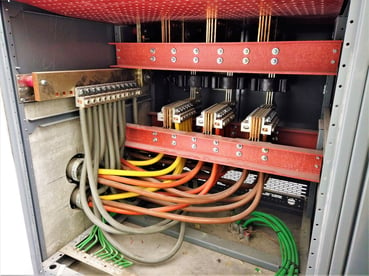
All conductors exhibit resistance, resulting in energy dissipated as heat. In building distribution systems operating at 480V and below, these losses accumulate across feeders, branch circuits, and internal distribution networks.
Over extended operating periods, incremental differences in conductor resistivity translate into measurable increases in energy consumption and thermal loading. This is especially relevant in large commercial facilities with continuous or high-duty-cycle loads.
Material Performance and Conductor Sizing
Copper’s electrical conductivity (approximately 100% IACS) enables equivalent current-carrying capacity with a smaller cross-sectional area compared to aluminum conductors. This has several implications within NEC-based design:
- Reduced conductor size for a given ampacity
- Lower voltage drop over equivalent distances
- Decreased heat generation under load
While aluminum conductors can be sized to meet code requirements, achieving comparable electrical performance often requires upsizing conductors, which affects conduit fill, bend radius, and equipment dimensions.
Impacts on Installation and Infrastructure
Higher conductivity and reduced conductor size enable more efficient use of physical space within building electrical systems. This affects both above-grade and below-grade installations.
In underground distribution systems—where duct banks, conduits, and thermal dissipation are critical design constraints—copper’s performance supports more compact installations and improved heat transfer characteristics. These factors align with the industry's increasing emphasis on system resilience, including the undergrounding of distribution feeders to mitigate outage risks.
Termination Stability and Maintenance Requirements
Connection integrity is a critical factor in long-term system performance. Copper exhibits lower thermal expansion and higher mechanical strength, making it less prone to creep and more resistant to fatigue from vibrations. The result is more stable terminations over time.
Which reduces the likelihood of:
- Increased contact resistance
- Localized heating at terminations
- Maintenance interventions such as retorquing
By comparison, aluminum conductors are more susceptible to deformation under heat and load, requiring stricter maintenance protocols to maintain connection integrity in accordance with manufacturer specifications and IEEE best practices.
Application Across Building Electrical Systems
Copper is widely used throughout building power distribution infrastructure, including:
- Service conductors and feeders
- Switchgear busbars and panelboard assemblies
- Dry-type and liquid-filled transformers
- Grounding and bonding systems (per NEC Article 250)
These applications demand consistent electrical and mechanical performance under normal and fault conditions, reinforcing the importance of conductor material properties.
High-Density Loads and Emerging Building Types 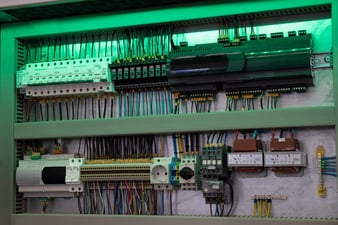
The increasing deployment of high-load facilities, including data centers and advanced manufacturing sites, is driving higher current densities and tighter design tolerances.
Such facilities often incorporate redundant power architectures, high-capacity feeders, and continuous operation requirements. In these environments, minimizing resistive losses and maintaining connection reliability are essential to system performance and uptime.
Material Efficiency and Circularity
From a lifecycle perspective, copper supports both operational efficiency and material sustainability. It requires less energy to produce than aluminum on a per-unit-conductivity basis and is highly recyclable.
Importantly, recycled copper can be refined to cathode-grade purity (~99.99%), enabling its reintroduction into electrical applications without performance degradation, consistent with circular economy principles and emerging ESG frameworks.
As building electrical systems evolve to support higher loads and increased operational demands, conductor performance becomes a key determinant of efficiency and reliability. Copper’s electrical, thermal, and mechanical properties support optimized system designs in accordance with NEC and industry standards.
For engineers, specifiers, and facility operators, copper remains a technically robust solution for achieving long-term system performance and lifecycle value.