By John Hipchen, Director of Energy and Electrical Systems Council for the Copper Development...
By Larry Peters, Project Manager for the Copper Development Association
Copper has shaped the built environment for centuries, from civic landmarks and educational institutions to residential and commercial facilities. Today, copper continues to play a vital role in building construction, supporting both new development and the renovation, expansion, and improvement of existing structures across industrial, commercial, and residential sectors. Its durability, adaptability, and long-term performance are driving renewed interest among architects, engineers, and construction professionals.
As building owners and project teams seek materials that balance performance, longevity, and design flexibility, copper remains a proven solution that meets modern construction demands while supporting long service life.
Summary: Copper’s durability, adaptability, and full recyclability are driving its renewed use in renovations, expansions, adaptive reuse, and new construction, where it delivers long service life and design continuity. It excels in roofs, façades, and envelopes through time-tested yet adaptable joinery methods, while modern applications like perforated screens improve shading, comfort, and energy efficiency. Copper supports sustainable building systems via strong thermal/electrical conductivity, enabling realistic lifecycle performance and material recovery. Current case studies highlight its evolving aesthetics, minimal maintenance, and long-term value across historic and contemporary contexts.
How Copper Supports Renovation, Expansion, and Adaptive Reuse
Renovation and expansion projects often require materials that can integrate new construction with existing structures.
Copper is commonly chosen for various applications due to its historical significance in built heritage. It also:
- Performs well in contemporary designs.
- Creates visual continuity via its unique natural finish between older and newer parts of a building.
- Develops a protective surface that evolves over time.
In expanding the New England Biolabs Facility, architects incorporated copper treated with a custom pre-patination process to support an expansion that acknowledged nearby historic structures while remaining relevant to modern design. The aqua-toned finish blends with its surroundings and will continue to develop character over time, strengthening the visual connection between new and existing buildings.
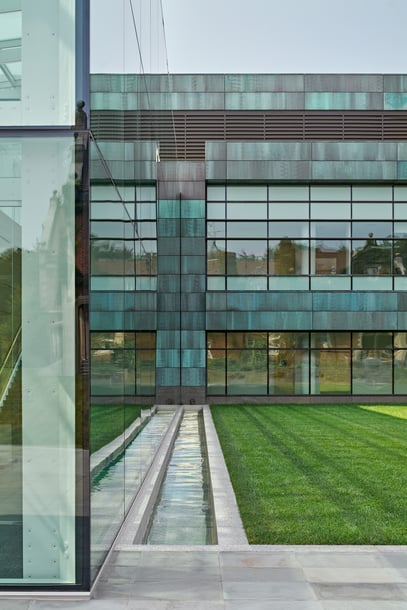
Photo Credit: Robert Benson
Architects value copper in adaptive reuse projects because of its longevity and minimal maintenance requirements. As Larry Kearns, FAIA, principal at Wheeler Kearns Architects, explains, “Because copper is long-lived, it’s pretty much unequal.” A well-designed copper addition can extend a building’s service life without frequent replacement.
“The payoff in using copper is that a building is not knocked down. It’s just adapted for a new use,” Kearns adds, reinforcing copper’s role in long-term investment and sustainable renovation strategies.
Copper’s Contribution to Sustainable Building Systems
Copper supports sustainable building practices through various key attributes:
- Durability: Copper is known for its long-lasting properties, making it a reliable choice in construction.
- Recyclability: It is 100% recyclable, retaining its material value at the end of a building’s life, which promotes responsible material recovery.
- Performance: Copper plays a vital role in the efficiency of critical building systems, including:
- Heating, Cooling, and Ventilation: Its excellent electrical and thermal conductivity enables efficient energy transfer.
- Thermal Recovery Systems: Copper is essential in thermal recovery heat exchangers, helping to reduce water use and reclaim heat energy within buildings.
- Water-Saving Technologies: Utilized in closed-loop and air-cooled systems, copper contributes to innovative, resource-efficient solutions.
“Copper could be up on a roof for more than a hundred years and still be completely recyclable,” says Tim Murphy of Revere Copper Products. This combination of long service life and recyclability supports realistic lifecycle analysis in sustainable construction.
Copper is also inherently low-emitting and contains no Volatile Organic Compounds (VOC), making it safe for use in decorative and interior applications.
Beyond increased efficiencies, a sustainable project is also an opportunity to improve the quality of life. In building the Hillside Senior Apartments in New York City, a standing-seam copper façade was incorporated to support energy-efficiency goals while enhancing the resident experience. Over time, the façade will naturally evolve in appearance without chemical coatings or intensive maintenance, connecting occupants to the aging of natural materials.
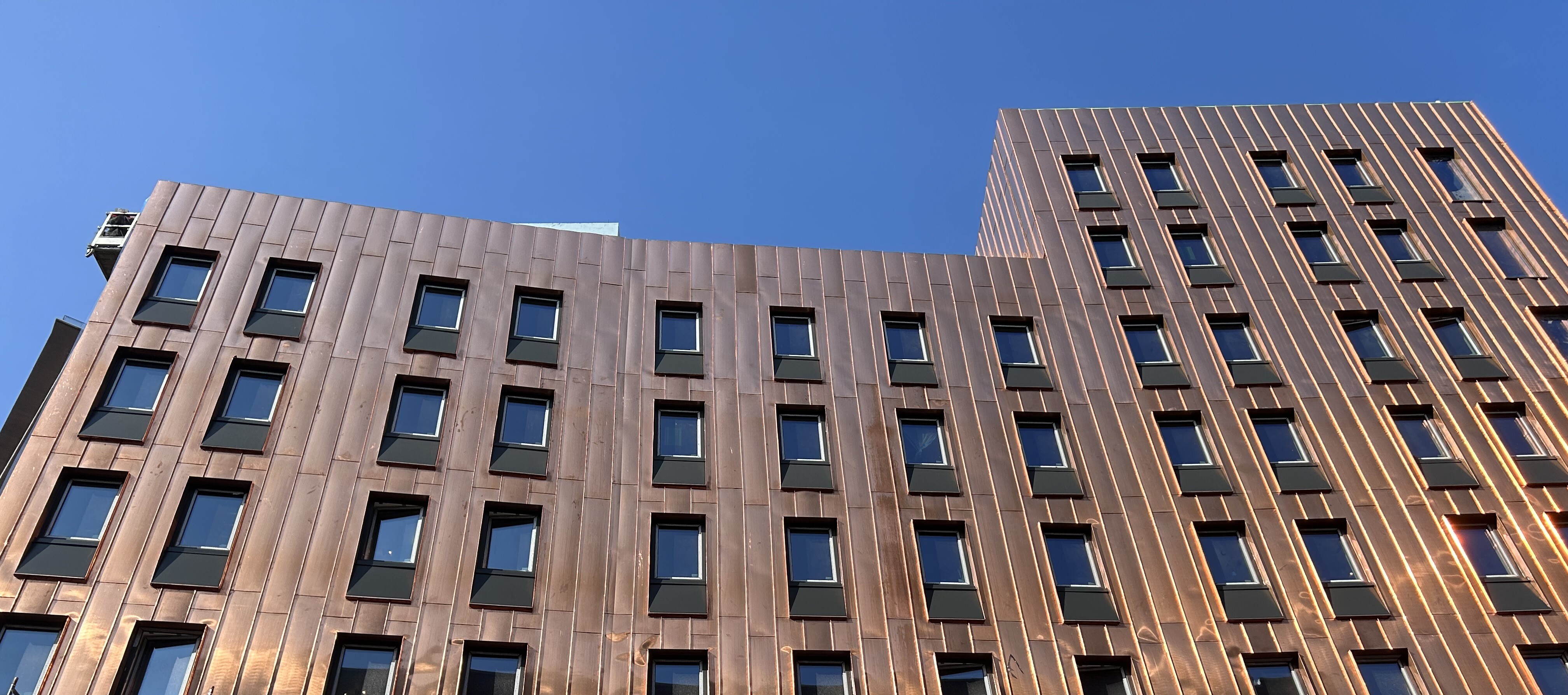
Photo Credit: SLCE Architects LLC
Proven Performance in Roofing and Building Envelopes
Copper’s reputation for reliability is well established in roofing and building envelope applications. Copper roofs have protected buildings for generations and often perform for more than a century. When historic copper roofs require restoration, project teams frequently choose copper again because of its proven durability.
At Temple Emanu El in Birmingham, Alabama, a 1912 copper dome was restored using a standing seam system with concealed cleats. The updated design preserved the historic appearance while improving watertight performance and long-term protection. Copper’s naturally forming patina protects against corrosion and resists moss and fungal growth, contributing to reliable performance in a range of climates. This durability has also made copper a trusted material for flashing and other critical envelope components.
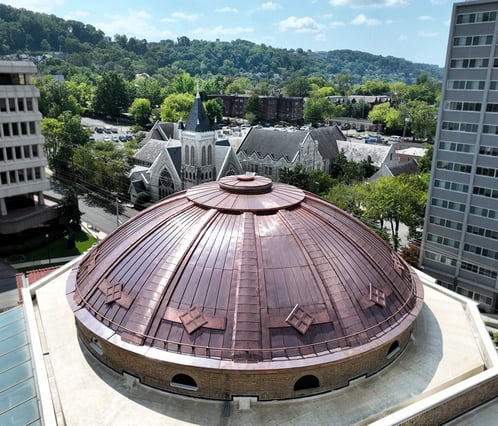
Photo Credit: CopperWorks Corp.
Advances in fabrication and mounting technology have expanded copper’s use beyond roofing into modern cladding and rainscreen systems. These applications allow copper to serve both functional and architectural roles on building façades.
Craftsmanship and Installation Techniques
Copper construction systems rely on time-tested installation methods developed over generations.
On flat surfaces, copper sheets can be soldered together to create a continuous, watertight surface. When properly executed, these joints provide exceptional durability. Soldering involves interconnecting copper seams with a metallic alloy of dramatically lower melting point. When done correctly, “it is a nearly impossible joint to fail,” says Kearns, adding that copper’s solderability is unique among other architectural metals. “I won't call it bulletproof, but it’s as near to bulletproof as you can get.”
On sloped roofs and façades, standing seam and batten seam systems are commonly used. These systems rely on interlocking seams and concealed cleats to accommodate thermal movement while eliminating fastener penetrations. Copper’s malleability allows it to be shaped for complex geometries while maintaining weather resistance and structural integrity. The results are designs with both timeless appearance and performance.
Perforated Copper for Passive Shading and Façade Performance
Perforated copper is increasingly used in building construction, offering a way to manage light, air, and heat while adding visual texture. These systems can support passive shading strategies that reduce solar heat gain and improve occupant comfort.
At Portsmouth Abbey School in Rhode Island, a new student center is enveloped by a copper brise-soleil and a perforated pergola. Architect Joe Tattoni, design principal at ikon.5 architects, explains the intent behind the design. “We wanted to honor the past, while being optimistic about the future. This needed to be something that went beyond 2025, but at the same time be a part of the campus language.”
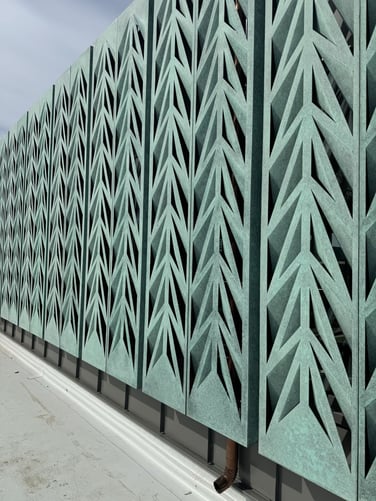
Photo Credit: Edd Cote
Mechanical engineer Francisco Duraes of Kohler Ronan describes how the perforated copper panels contributed to energy performance. “The copper paneling ultimately reduced solar heat gain into the space that the HVAC system had to contend with to maintain the space at comfortable temperatures,” he says, noting that the design allowed different thermal conditions in occupied and unoccupied zones.
Perforated copper systems can be engineered to respond to solar orientation or used as expressive façade elements, combining performance and architectural intent.
A Trusted Material for Long-Term Construction Performance
Copper remains a trusted material in building construction because it delivers consistent performance across a wide range of applications. Its durability supports extended building service life, while its adaptability allows it to perform in both historic and modern contexts.
From roofing and façades to mechanical systems and architectural features, copper contributes to resilient construction that prioritizes longevity, efficiency, and responsible material use. These qualities continue to make copper a reliable choice for projects focused on long-term building performance.