By Marcus Elmer, Vice President and Director, Tube & Fittings Council for the Copper Development...
Overview
-
Global cooling demand is rising rapidly, pushing HVAC/R manufacturers to improve efficiency while reducing refrigerant charge, material use, and equipment size.
-
Enhanced small-diameter copper tubes can improve heat transfer, support more compact coils, and reduce internal volume, but successful designs require optimized circuitry, fins, and refrigerant flow.
-
Adoption is expanding across North America, Asia, and Europe, with manufacturers using 5 mm and 7 mm copper tubes in heat pumps, commercial equipment, and other HVAC/R applications.
-
Recent case studies show that optimized SDCT designs can reduce heat exchanger weight, pressure drop, material mass, and internal volume while maintaining or improving performance.
-
Research is already moving toward 3 mm and 4 mm tubes, signaling continued development of smaller, higher-performance heat exchangers for next-generation HVAC/R systems.
Global demand for cooling is rising, while HVAC/R manufacturers are being asked to reduce energy use, refrigerant charge, material consumption, and equipment footprint.
Building Services Research and Intelligence Association’s (BSRIA) 2026 worldwide air-conditioning and heat pump research found that global cooling demand has increased 245% since 2010. Its analysis of 18 major air-conditioning markets and 15 heat pump markets points to technology advances, tighter regulation, and fast-growing data center cooling requirements as major forces reshaping equipment design.
A June 2026 CDA member-only market study highlights the same shift toward high-value commercial and high-volume residential markets.
One response is increasingly visible in the heat exchanger itself: smaller-diameter copper tubes, including internally enhanced or microgrooved designs.
Small-diameter copper tube, or SDCT, technology has been developing for years, but recent product introductions, case studies, and research suggest that it is moving deeper into mainstream HVAC/R equipment. Applications now span residential and commercial heat pumps, refrigeration, dehumidification, and specialized cooling. The design trend is also moving beyond 5 mm and 7 mm tubing, with researchers examining 3 mm and 4 mm round-tube heat exchangers.
Why HVAC/R Manufacturers Are Reducing Tube Diameters
The principle behind SDCT is straightforward. Reducing tube diameter increases surface area relative to internal volume. With properly designed tube circuitry, fins, and refrigerant flow paths, manufacturers can use that geometry to maintain or increase heat exchanger performance while reducing material and refrigerant requirements.
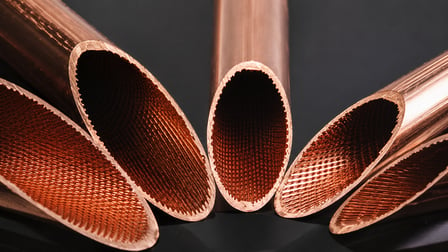
Internal enhancements add another layer. Internal grooving within the copper tube increases the internal surface area and disrupts the refrigerant-side boundary layer, thereby improving heat transfer.
Tube diameter, internal geometry, fin design, and refrigerant distribution need to be considered together. Smaller tubes can improve refrigerant-side heat transfer and enable more compact coils, but circuitry must be optimized to control pressure drop and distribution.
That engineering balance is important. Smaller diameter alone does not guarantee a better heat exchanger.
For example, a 2019 research report on refrigerated cabinet heat exchangers by the University of Shanghai for Science and Technology's Institute of Refrigeration Technology has shown that decreasing tube diameter can increase heat-transfer coefficients, while also increasing refrigerant velocity and pressure-drop risk if flow paths are not redesigned appropriately. The result is a design problem that increasingly favors simulation and system-level optimization rather than simple component substitution.
Adoption Is Becoming Visible Across Global HVAC/R Markets
Evidence from major HVAC/R markets suggests SDCT is expanding beyond isolated development programs.
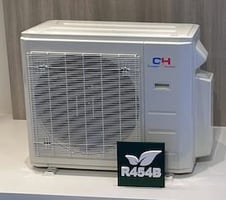
- At the 2025 AHR Expo in North America, manufacturers displayed 5 mm and 7 mm copper tube designs across residential, commercial, and industrial equipment. Examples documented by CDA included 7 mm tubing in Midea’s M Thermal Arctic air-to-water heat pump, 5 mm coils in Daikin commercial equipment, and smaller-diameter copper in products from Gree Electric Appliances, Samsung, GE Appliances, and Rheem.
- In Asia, the International Copper Association’s (ICA) coverage of the Appliances & Electronics World Expo 2025 highlighted Midea’s R290 SDCT heat exchanger technology as one example of manufacturers combining smaller tube geometries with low-GWP refrigerants. The region is especially significant because Asian OEMs account for a large share of global air-conditioning and heat pump manufacturing.
- European manufacturers and coil suppliers are also working with smaller-diameter round-tube plate-fin designs. ICA’s European market overview identifies companies such as Karyer that use 5 mm copper tube technology and points to continued development in heat pumps, refrigeration, and lower-GWP systems.
These examples show that smaller copper geometries are becoming another established design option across multiple equipment categories and regions.
Case Studies Show the Value of System-Level Optimization
Recent engineering work helps explain why manufacturers are investigating the technology.
Heat Pump Laundry Appliance
A case study involving Whirlpool, OTS R&D, and CDA examined a heat pump laundry appliance transitioning away from R134a. More than 55,700 candidate evaporator models were analyzed. Proposed designs shifted from 8 mm aluminum tubes to 5 mm copper tubes and changed the fin configuration. Among the preferred simulated designs, evaporator weight reductions ranged from 9% to 76%, air-side pressure drop reductions ranged from 2% to 79%, and latent load increased by up to 6% compared with the baseline when using the alternative refrigerant. The 5 mm condenser candidates also reduced weight while maintaining or improving thermal performance.
Commercial Dehumidifiers
A separate AprilAire optimization project evaluated tube-fin geometries for commercial dehumidifiers operating under standard and low-temperature conditions. The optimized 5 mm design was predicted to increase dehumidification rate and efficiency by 5%, reduce material mass by 15%, and cut heat exchanger internal volume by 60%. Lower internal volume is particularly relevant, because it creates an opportunity to reduce refrigerant charge alongside equipment size and material use.
Cold-Climate Heat Pumps
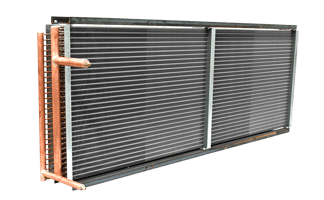
Research into cold-climate heat pumps offers another example. A 2023 paper from the International Congress of Refrigeration evaluated smaller-diameter copper evaporator coils using low-GWP refrigerants. Researchers modeled different microfin geometries, fin configurations, tube spacings, and circuit arrangements before building a prototype. A four-row, 5 mm copper-tube evaporator achieved the targeted 15 kW capacity using R290, with test results aligning well with simulations. (See table 2 below.)
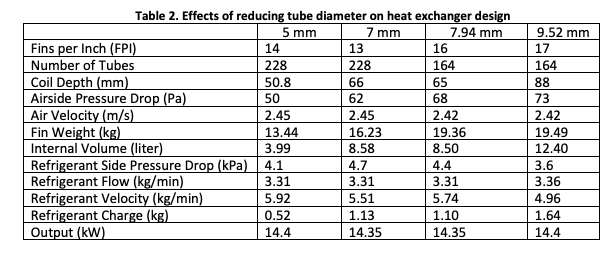
Together, these projects demonstrate why optimization software has become important to SDCT development. Designers can simultaneously evaluate capacity, refrigerant charge, pressure drop, material mass, fin geometry, and circuitry, rather than treating tube diameter as an isolated variable.
Research Is Moving Toward 3 mm and 4 mm Tubes
The next stage of development may involve even smaller diameters.
A CDA member-only report on the 2026 ASHRAE Annual Conference indicates that Technical Committee 8.4, Air-to-Refrigerant Heat Transfer Equipment, was developing a research request covering 3-mm and 4-mm round-tube fin heat exchangers. The proposed work would generate test data to validate existing air-side correlations for these smaller geometries.
That research direction matters because moving below 5 mm increases both the potential benefits and the engineering complexity. Accurate correlations for air-side performance, refrigerant flow, heat transfer, and pressure drop become increasingly important as designers reduce dimensions.
The same ASHRAE conference also reflected how quickly the broader cooling market is changing. Sessions devoted significant attention to AI and data center cooling, low-GWP refrigerants, and system optimization. These applications increase the need for compact heat-transfer technologies capable of meeting higher thermal loads under tighter efficiency and space constraints.
What the Shift Means for HVAC/R Equipment Designers
Enhanced small-diameter copper tubes give engineers another way to address several design constraints at once:
- A smaller internal volume can help reduce refrigerant charge.
- Increased surface-area-to-volume ratios and internal enhancements can improve heat transfer.
- Tighter tube spacing can support smaller coils.
- Reduced material requirements can lower heat exchanger mass.
The tradeoffs remain application-specific. Pressure drop, refrigerant distribution, defrost behavior, air-side resistance, fin geometry, manufacturing tolerances, and serviceability all need to be considered.
For that reason, the global shift toward SDCT is closely tied to advances in simulation, optimization, and testing. The most successful designs are unlikely to result from simply replacing a conventional tube with a smaller one. They will come from redesigning the heat exchanger around the properties of the smaller tube and the refrigerant being used.
As heat pumps expand, low-GWP refrigerants become more common and cooling loads grow, the ability to extract more heat-transfer performance from a smaller volume of material will become increasingly valuable.
Frequently Asked Questions