Overview Global cooling demand is rising rapidly, pushing HVAC/R manufacturers to improve...
The AHR Expo, the largest showcase for HVACR technology in North America, serves as a focal point for both established and emerging trends. The market is moving toward higher-efficiency systems, reduced environmental impact, and more compact equipment. Engineers, manufacturers, and system designers are aligning around new performance priorities: Refrigerant optimization, thermal efficiency, and intelligent system control.
Several themes stood out across the exhibition floor:
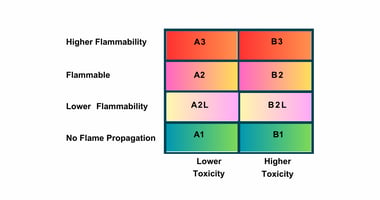
- Manufacturers are switching to low-global-warming-potential (GWP) refrigerants such as R32, R290, and R744, while simultaneously redesigning systems to minimize refrigerant charge and maximize energy efficiency.
- Artificial intelligence is transforming control systems and building management strategies.
- The increase in data center cooling needs, driven by advanced computing, is propelling significant innovation.
Within these technological changes, small-diameter copper tubing has served as an important design element. Systems that use 5 mm and 7 mm copper tubes now define many of the most advanced HVACR platforms on display.
Small-Diameter Copper Tubing Reshapes System Design
Manufacturers are moving away from traditional 9.35mm (3/8-inch) and larger tubing toward 7 mm and 5 mm copper tubes across a range of applications. These include larger-scale variable refrigerant flow (VRF) systems, residential split systems, dedicated heat pumps, and commercial refrigeration equipment.
Small-diameter copper tubes deliver several measurable performance benefits:
- Reduced refrigerant charge: A smaller internal volume directly reduces the amount of refrigerant required in the system. This reduction helps manufacturers meet evolving safety standards and environmental regulations while also lowering system cost (see next:).
- Improved heat transfer performance: Smaller diameters increase the surface-area-to-volume ratio, promoting greater refrigerant turbulence and enhancing heat transfer coefficients and overall system efficiency.
- Compact system design with smaller tubing: Design engineers can reduce coil size and overall equipment footprint without sacrificing performance. This supports the growing demand for space-efficient HVAC solutions in residential, commercial, and industrial environments.
- Improved pressure handling: Smaller copper tubes typically offer higher burst strength, supporting the adoption of modern high-pressure refrigerants such as CO2.
Several manufacturers demonstrated these advantages in real systems at the expo:
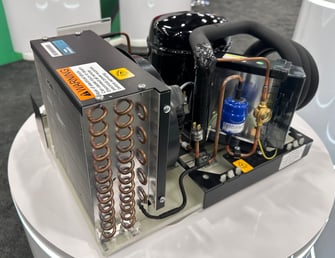
- Embraco presented its EDP display case cooling systems, which use 5 mm copper tubes in the condenser (bottom left). These
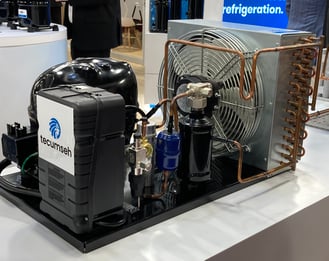
systems achieve significant reductions in refrigerant charge while improving heat transfer efficiency and lowering airside pressure drop. - Tecumseh showcased condensing units that incorporate 5 mm and 7 mm copper tube coils for refrigeration applications (bottom right).
- FB Industrial highlighted its manufacturing of 5 mm and 7 mm copper coils designed for both refrigeration and chiller systems.
Why 7 mm Copper Tubing Is Becoming the Baseline for HVAC Systems
Across the expo floor, 7 mm copper tubing appeared consistently in heat pumps, residential split systems, and VRF platforms. Growing in popularity, using 7 mm copper tubing provides a balance between efficiency, manageable pressure drop, and manufacturing compatibility.
By adopting 7 mm tubing, manufacturers achieve lower refrigerant charges and improved thermal performance, while also enabling more compact outdoor units that are easier to install and better suited for limited spaces.
Additionally, 7 mm systems consistently deliver better performance in cold climates, ensuring reliable heat pump operation even in challenging conditions. The growing use of this format reflects a strong industry consensus on its versatility and effectiveness.
Some examples seen at AHR 2026 included:
- Daikin featured VRV systems built around a 7 mm copper tube architecture.
- Hitachi presented its Air365 and airCore 700 platforms.
- Samsung showcased its DVM S2 VRF systems.
- Panasonic highlighted mini-split systems that use similar tubing strategies.
- GE, through Haier, introduced the MRV 7 platform.
5 mm Copper Tube Technology Advances Refrigeration Design
While 7 mm copper tubing is now standard in many HVAC applications, 5 mm copper tubing is used widely in refrigeration and compact cooling systems. Manufacturers use 5 mm tubing in commercial refrigeration, display cases, and compact evaporators to achieve multiple system benefits.
The smaller diameter allows for a significant reduction in refrigerant charge, often by 20-40 percent compared to larger tubing, supporting environmental goals and reducing operating costs. In addition, 5 mm tubes reduce airside pressure drop, thereby improving airflow efficiency. As a result, design engineers can specify lower power fans, further improving energy savings and overall system performance.
Some examples seen at AHR 2026 included: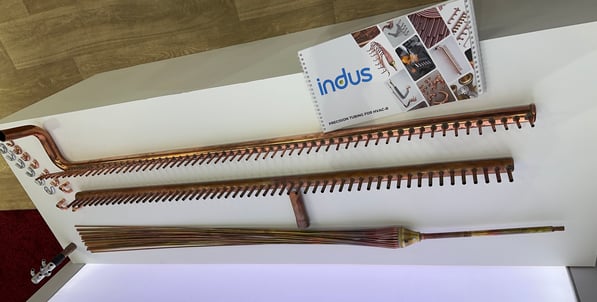
- Comfort Aire displayed PTAC units that incorporate 5 mm copper tube condensers.
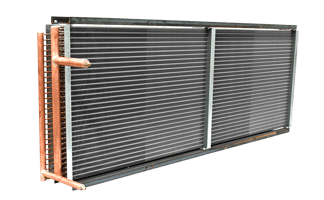
- Indus Coils presented a large L-shaped 5 mm coil designed for data center cooling and indicated ongoing development of 4 mm tube technology (see right).
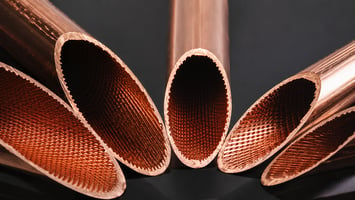
- KRN Heat Exchanger and Refrigeration showcased microgroove copper tube designs that enhance thermal performance in refrigeration systems.
These developments highlight how 5 mm tubing supports both performance and sustainability objectives.
Data Center Cooling Drives High-Density Thermal Innovation
The modern uprising of artificial intelligence is placing high demands on data center cooling systems. With modern AI chips generating thermal loads of several kilowatts each, traditional air cooling methods can’t keep pace with the intense heat output. To manage such heat loads, manufacturers are advancing liquid-cooling methods to maximize performance and efficiency.
Direct-to-chip cooling solutions use cold plates, coolant distribution units, and precisely engineered liquid circuits to remove heat directly at the source, enabling higher computing density and more reliable operation.
Copper is essential in these designs, for a number of reasons, most importantly its proven reliability under extreme heat flux. Engineers incorporate copper into cold plates, heat exchangers, and high-density coils, ensuring optimal heat transfer and long-term performance.
Some examples seen at AHR 2026: C4916.jpg?width=291&height=227&name=Daikin%20(Chilldyne)C4916.jpg)
- LG unveiled its direct-to-chip cold plate cooling systems
- Daikin introduced the innovative Chilldyne liquid cooling technology (see left).
Both showcased the industry’s commitment to copper-based components.
Low GWP Refrigerants Driving New Approaches
Global regulatory frameworks continue to push the industry toward refrigerants with lower environmental impact. R32, R290, and R744 are now central to system design strategies.
These refrigerants introduce new engineering requirements. Some systems, like R744, must operate at higher pressures, achieve greater heat exchanger efficiency, and some need to minimize refrigerant charge.
Small-diameter copper tubing directly supports all these requirements. It enables compact heat exchanger designs that improve efficiency while reducing refrigerant volume. It also provides the strength needed to handle higher operating pressures.
Integrated Systems and Intelligent Controls Redefine HVAC Operation
Manufacturers are equipping HVAC systems with advanced AI to enable predictive energy management, real-time optimization, and more accurate load forecasting. These intelligent controls help maximize efficiency, reduce energy consumption, and support proactive maintenance.
Some examples seen at AHR 2026:
- LG showcased its Multi V i VRF system, which uses predictive algorithms to optimize cooling performance.
- Trane demonstrated building solutions that incorporate AI-driven automation for system-wide efficiency gains.
At the same time, the industry is adopting modular system design, enabling scalable VRF platforms, modular chillers, and integrated heat pump solutions that better adapt to varying building needs.
The ongoing shift toward electrification is also accelerating, with air-to-water heat pumps gaining momentum as a cleaner, more efficient alternative to traditional combustion-based heating systems.
What’s Next for Small-Diameter Copper Tubes?
The move toward small-diameter copper tubing is transforming HVACR engineering and manufacturing. Engineers are creating more compact heat exchangers and optimizing fin and tube layouts, while manufacturers improve tube-bending precision and brazing for smaller diameters. Installers and technicians are adjusting to systems that require updated handling and service methods.
Next-generation developments are already underway, including 4 mm copper tube designs for ultra-compact systems and improved internal geometries for better heat transfer. Hybrid heat exchangers that combine multiple materials are also being explored. Companies like Indus Coils are working on 4 mm tubing concepts, and KRN is expanding microgroove technology to boost efficiency.
These innovations will further cut refrigerant charge, reduce equipment size, and enhance overall system performance.
Join the #CopperConversation and engage with our videos, thought leadership articles, reports, and more to see why copper is the right choice for OEMs.
Frequently Asked Questions